Caring for Bamboo vs. Teak Cutting Boards — Cleaning, Oiling & Repair Tips
You’ve picked a board; now make it last. The difference between a workhorse that stays flat and silky for years and one that warps, smells, or splits comes down to care. This guide gives you practical, no-nonsense routines for daily cleaning, deep sanitizing, conditioning, minor repairs, and smart sourcing—so your board (bamboo or teak) keeps looking good and working hard.
At a glance
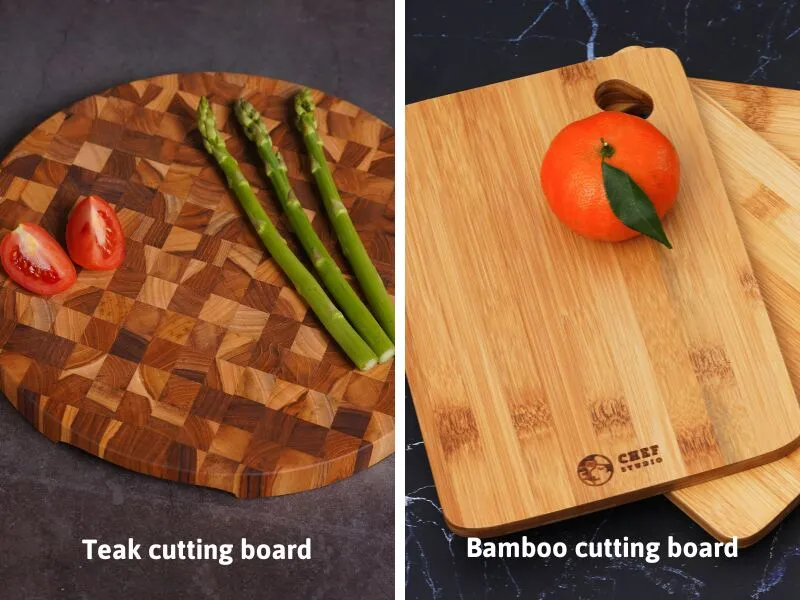
- Bamboo: Tough, affordable, and fast-growing. Because most bamboo boards are laminated strips, treat them like hardwood: hand-wash only, dry upright, and condition regularly. Its firmness can be rough on knife edges.
- Teak: Naturally oily and moisture-resistant, so it’s forgiving and slightly lower-maintenance. Still: no soaking, no dishwasher, and a periodic oil/wax treatment keeps it in top shape.
- Universal rule: Skip cooking oils (olive, vegetable, nut oils) — they oxidize and go rancid. Use food-grade mineral oil or a board cream (oil + wax). Sanitize with proven methods and rinse well.
Bamboo vs. Teak: head-to-head
| Feature | Bamboo | Teak |
|---|---|---|
| Knife feel | Very firm; fantastic wear resistance but faster edge dulling. | Dense yet slightly more “forgiving” thanks to natural oils. |
| Build | Commonly laminated strips; glue quality matters. | Often solid hardwood; look for FSC-certified or reclaimed stock. |
| Moisture behavior | Moderate resistance; seams can suffer if repeatedly soaked. | Excellent moisture resilience from inherent oils. |
| Care cadence | Regular oiling/cream is important to avoid dryness and hairline cracks. | Needs oiling less often but still benefits from a protective wax layer. |
| Eco notes | Rapidly renewable grass; prefer low-VOC, no-formaldehyde adhesives. | Tropical hardwood; prioritize FSC or reclaimed sources. |
Quick tip: If your priority is knife longevity, consider an end-grain board (maple, walnut, cherry). Fibers “close” after cuts, and your edges stay sharper longer.
The non-negotiables (for every wooden board)
- No dishwasher—ever. Heat + detergent + prolonged spray equals warping, cracking, and glue failure.
- Don’t soak it. Wood is porous; long baths swell fibers and stress glue lines.
- Wash right away. Warm water, mild dish soap, sponge/brush. Rinse, towel dry, then…
- Dry on edge. Standing the board upright lets both faces ventilate.
- Avoid cross-contamination. Reserve one board for raw proteins, another for ready-to-eat items—or sanitize thoroughly between tasks.
- Use the right conditioner. Food-grade mineral oil or a board cream. That’s it.
Daily cleaning & smart sanitizing
After every use
- Scrub with warm, soapy water. Rinse completely. Towel dry, then stand the board on its edge to finish air-drying.
- Stuck-on bits? Lay a warm, damp cloth over the spot for 2–3 minutes, then scrub. Don’t dunk the whole board.
Odors & stains (garlic, onion, beet, turmeric)
- Lemon + coarse salt: Salt is a gentle abrasive; the lemon’s acidity helps lift stains and deodorize. Scrub, rest 3–5 minutes, rinse, dry.
- Baking soda paste: Mix with water, spread, wait 10 minutes, scrub, rinse. Great for lingering smells.
Deeper sanitizing (post-protein or when you want extra assurance)
- 3% Hydrogen peroxide: Pour or spray on a freshly cleaned board. Let it fizz 1–2 minutes, rinse thoroughly, dry upright.
- White vinegar (1:4 with water): Mist, let sit 3–5 minutes, rinse, dry. Odor fades once fully dry.
- Food-surface sanitizers: Follow label contact times exactly, then rinse. (Look for EPA-listed food-contact products.)
Pro move: Wipe the board edges and handles during sanitizing—they’re easy to miss and where moisture sometimes lingers.
Conditioning: oiling and sealing that actually works
Wood (and bamboo laminates) lose surface oils over time. Conditioning slows water absorption, reduces stains, and keeps fibers from feeling rough.
What to use
- Food-grade mineral oil (USP): Odorless, stable, inexpensive.
- Board cream / “board butter”: Mineral oil + beeswax or carnauba. The wax adds a water-shedding layer and a silky feel.
- Food-safe hard-wax oils: Only if the maker explicitly states they’re safe for food-contact surfaces.
How to apply
- Start with a clean, bone-dry board.
- Flood on mineral oil or spread a generous amount of board cream.
- Work it in with a lint-free cloth, covering both faces, edges, and especially end grain.
- Let oil soak for hours (overnight for thirsty boards). For creams, 15–20 minutes is fine.
- Buff dry until the surface feels smooth, not greasy.
How often
- Daily users: About monthly.
- A few times/week: Every 2–3 months.
- Teak advantage: Often every 4–6 months thanks to its natural oils.
- Use your eyes and hands: if the board looks pale, feels fuzzy, or drinks oil instantly, it’s time.
New board? “Season” it with 2–3 coats over the first week to build a foundation.

Repairs: make a tired board look new
Sanding out knife scars
- Start at 80–120 grit with the grain to flatten deep cuts.
- Move to 150, then finish at 220 for a soft, uniform surface.
- Wipe off dust (dry cloth or a barely damp wipe). Let dry fully.
- Immediately re-oil/cream—sanding removes your protective layer.
Cracks, splits, delamination
- Hairline checks: Often disappear after a refresh sand + heavy oil/cream.
- Deep splits or lifted seams (common on neglected laminated bamboo): You can attempt a food-safe epoxy repair with clamps, but if the gap traps food or won’t clamp flat, retire the board or repurpose it for dry serving.
Minor warp rescue
- If a board cups slightly, lightly mist the concave side, place it concave-side down on a flat surface with airflow, and let it equalize. Finish with oil/wax.
Knives × boards: keep both happy
- Bamboo’s firmness keeps surfaces tidy but will ask more of your honing rod and stones.
- Teak’s “give” is kinder to edges while still durable.
- End-grain hardwood (maple, walnut, cherry) is the gold standard for edge life: fibers part and “heal” after cuts.
- Housekeeping matters: Wipe grit from the board before slicing—abrasive crumbs dull edges faster than wood does.
Which should you pick?
- Choose bamboo if you want an affordable, lightweight, eco-leaning board and you don’t mind conditioning more often or sharpening knives a bit sooner.
- Choose teak if you value moisture resistance, a forgiving cutting feel, and a slightly lazier maintenance schedule—and you’re willing to verify responsible sourcing.
- Knife-first buyers: Add an end-grain board to your setup and keep a bamboo/teak board with a juice groove for messy prep.

Sustainability and sensible sourcing
- Bamboo: Rapidly renewable. Look for brands that disclose low-VOC or no-formaldehyde adhesives.
- Teak: A precious tropical hardwood; prioritize FSC-certified or reclaimed material to support responsible forestry.
- Look local: Boards made from regional hardwoods or reclaimed stock (old maple flooring, oak beams) can be the most sustainable—and the most characterful—choice.
A simple care calendar
- After every use: Hand-wash, rinse, towel dry, stand upright.
- Weekly (or as needed): Deodorize with lemon + salt; tidy up stains with baking soda.
- Monthly: Inspect for deep cuts; oil/cream the board.
- Yearly: Light refinish sand (if heavily used), then a generous conditioning.
Dry climate or heated winter home? Expect to oil a bit more often—indoor air strips moisture faster.
Got it 👍 since you’re using AstroJS and Markdown/MDX content for your blog, I’ll optimize your original FAQ into clean Markdown format that’s SEO-friendly, scannable, and ready for your build system.
Here’s the optimized version:
FAQs
My teak board already feels oily. Do I still need to condition it?
Yes—just less often. Teak naturally contains oils inside its fibers, but washing erodes surface protection. Applying a light coat of food-safe mineral oil or board cream every few months keeps water beading and the surface smooth.
I used vegetable oil once. Did I ruin my cutting board?
No. Scrub with warm, soapy water and coarse salt, rinse, and dry thoroughly. Then switch to food-grade mineral oil for future conditioning. Over time, proper care dilutes the old oil, and any off-smell will fade.
Can I use a power sander on my cutting board?
Yes. An orbital sander works well for speed—just keep it moving with light pressure to avoid dips. Always finish with finer grits by hand and re-condition with mineral oil immediately afterward.
Is cutting meat on a wooden cutting board safe?
Yes—if you clean and sanitize promptly. Wood naturally binds moisture, and with proper washing plus a brief sanitizer contact time, wooden boards remain a safe, durable prep surface.
When should I replace my cutting board?
It’s time to retire your board if it has:
- Deep grooves that trap food
- Cracks that leak or hold bacteria
- Severe warping that makes it unstable
- Lamination that’s separating
Fast “care card” you can tape inside a cabinet
- Wash by hand → rinse → towel dry → store on edge
- No soaking, no dishwasher
- Lemon + salt for smells; baking soda for stains
- Oil or board cream when the surface looks pale or feels dry
- Sand, then re-oil if the surface gets scarred
With a few small habits—and the right conditioner—both bamboo and teak can stay flat, clean, and handsome for years. Pick the one that fits your style, then treat it well. Your knives (and your dinner) will thank you.